

Lactose in Breast Milk: What Parents Should Know
Date: 12.08.2026

Lactose is the main carbohydrate in breast milk and a natural part of an infant’s diet from the very first days of life. For the baby’s body to use its components, lactose must be broken down into glucose and galactose with the help of the lactase enzyme. This process is especially important during the first months of life, when breast milk or infant formula forms the basis of the baby’s diet. Here we explain how lactose digestion works in infants and what role lactase plays in this process.
What is lactose in breast milk?
Lactose, also known as milk sugar, is made up of glucose and galactose. For these components to be used by the body, the lactose molecule must first be broken down. This process involves lactase, an enzyme produced in the small intestine.
So, lactose and lactase are not the same thing. Lactose comes from milk, while lactase is the enzyme that breaks it down. You can read more about the difference in the article “Lactase and lactose: what is the difference and why are they important for babies?”.
How is lactose broken down in babies?
The lactase enzyme splits lactose into glucose and galactose. If some of the milk sugar remains undigested, it may pass further into the intestine and take part in fermentation processes.
However, it is important not to draw conclusions based only on a baby’s behaviour after feeding. There may be many different reasons for fussiness or discomfort. If the same situation occurs repeatedly, it is best to discuss it with a paediatrician.
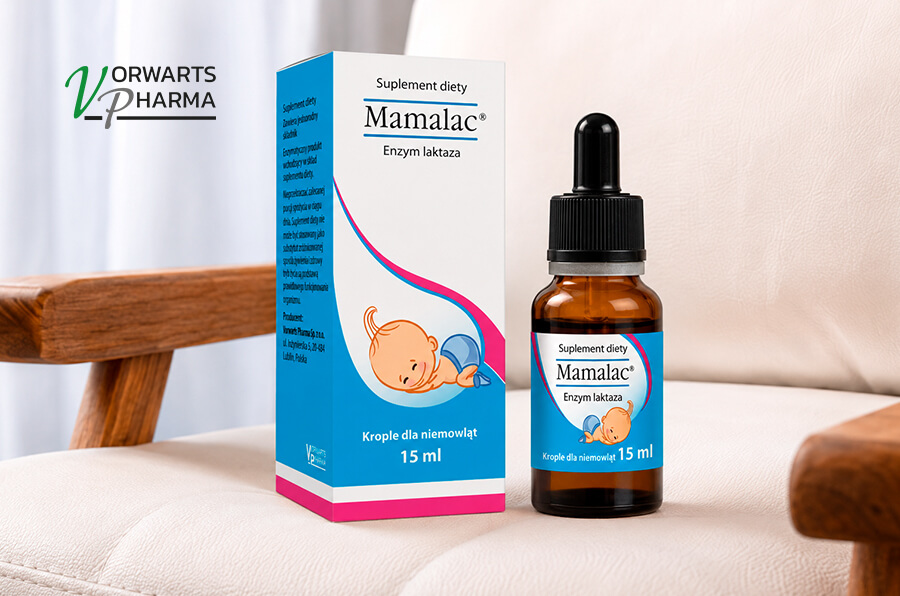
Mamalac with lactase enzyme for infants
Mamalac contains the lactase enzyme for breaking down lactose in breast milk or infant formula. Lactase separates milk sugar into simpler components — glucose and galactose.
How Mamalac is used depends on the type of feeding. During breastfeeding, the required number of drops, according to the dosage table, is given to the baby before feeding. If the baby is formula-fed, Mamalac drops are added to properly prepared infant formula. The product is used with each feeding according to the instructions.
There is also one small but important practical detail: the lactase enzyme is sensitive to high temperatures, so Mamalac should not be added to hot breast milk or hot infant formula.
Mamalac for breastfeeding and infant formula
There is no need to change the baby’s usual feeding method when using Mamalac. During breastfeeding, the drops are given before the baby is put to the breast. When using infant formula, the drops are added to the correctly prepared portion of formula.
In this way, the lactase enzyme is used during the period when milk-based feeding forms the main part of the infant’s diet. The number of drops should be determined according to the dosage table, taking into account the baby’s age and feeding volume.
FAQ
Does breast milk contain lactose?
Yes. Lactose is a natural carbohydrate found in breast milk.
What breaks down lactose in babies?
The lactase enzyme is needed to break down milk sugar.
Can Mamalac be used while breastfeeding?
Yes. According to the instructions, the required number of drops is given to the baby before breastfeeding.
How should Mamalac be used with infant formula?
The drops are added to properly prepared infant formula in the amount indicated in the dosage table.
Before use, read the instructions and consult a paediatrician.
A dietary supplement does not replace a complete and balanced diet.
111


